
Resources
Articles
August 12, 2026
“I Believe. Lord, Use Me to Help Others Believe.”— Always Be Ready
by Marian Christopherson
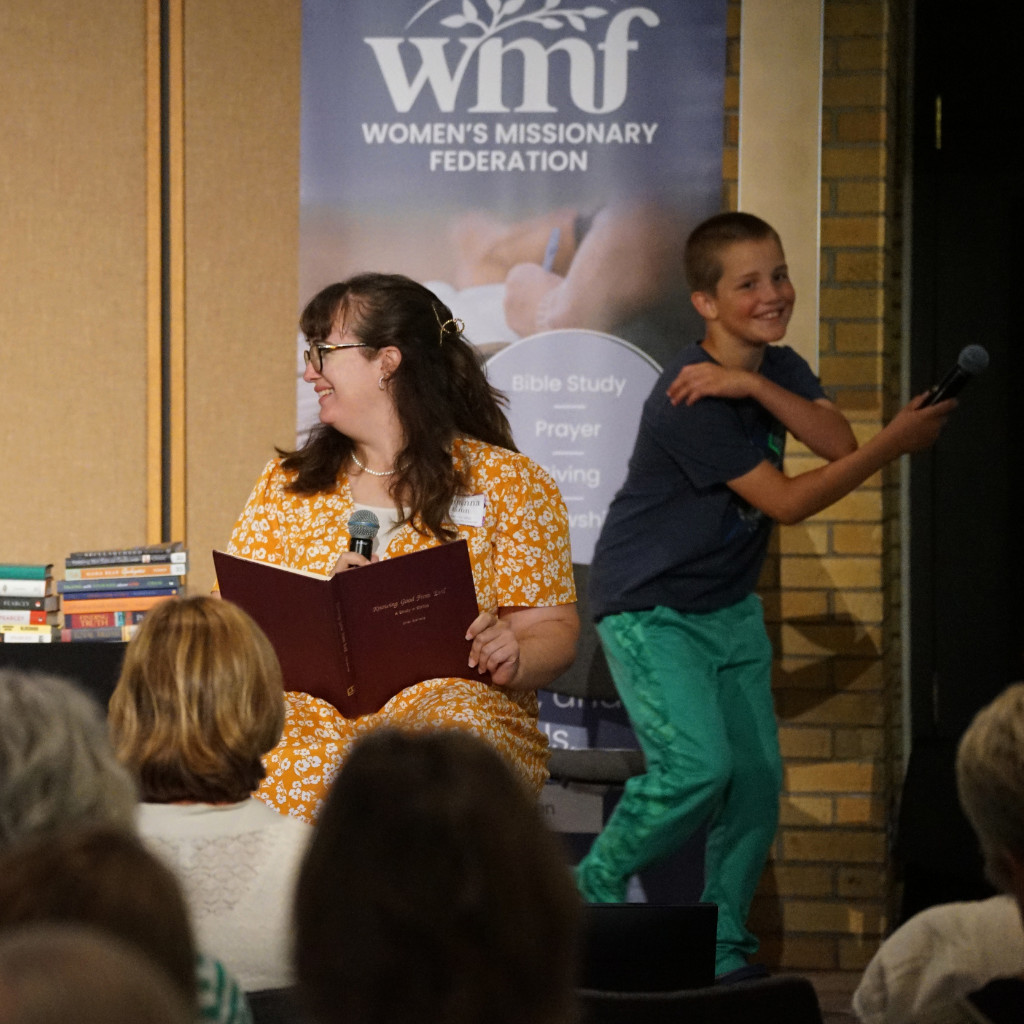
Adapted from Marian Christopherson’s WMF Session at the 2026 AFLC Annual Conference, Part 2
“But sanctify Christ as Lord in your hearts, always being ready to make a defense to everyone who asks you to give an account for the hope that is in you, yet with gentleness and reverence.” (1 Peter 3:15 NASB)
Notice the timing in this verse: Always ready. Who should be ready? There are no age restrictions, no limitations on station, vocation, or occupation. In any setting at any time, Peter instructs us to be ready to give an answer (apologia).
When people ask you, “Why do you have peace and hope when the world is falling apart?” Be ready to give an answer. When people ask you, “Aren’t all religions the same?” Be ready to give an answer. Think for a moment: What questions do you want to be ready to answer?
Give your answer with gentleness and reverence (1 Peter 3:15). The tone of our response should show the compassion and kindness of Jesus living through us.
How do we as the people of God get “ready”?
1. We start early, nurturing faith formation in families and in the community of faith.
We prepare children for the real world, the real questions they will face, the real heartaches they will experience—we don’t hide these things from them, but model how to navigate through them, with wisdom and discernment.
Deuteronomy 6 gives helpful and practical guidance for what this looks like in the family and in the community of faith. “You shall teach [these words] diligently to your sons and shall talk of them when you sit in your house and when you walk by the way and when you lie down and when you rise up” (Deuteronomy 6:7). Notice the double merism (a rhetorical device that expresses totality by pairing opposites): sit/walk, lie down/rise up includes everything in between—wherever you go, whatever you do.
Matthew 28:19-20 builds on this idea, where we see that “Go” literally means “As you are in the process of going,” baptize and teach. We bring our infants to the Lord in baptism and train them up in the fear of the Lord, praying that they will continue to grow in their faith with no gaps! That is God’s ideal. As they grow, we guide children in developing a Christian worldview—a clear lens through which to see and interpret the world. This is more than believing Jesus died for my sins. This is how we teach Total Truth, integrating our relationship with God into ALL aspects of life.
First Thessalonians 5:21 gives further instructions:
2. “Examine everything carefully; hold fast to that which is good” (NASB). Nancy Pearcey in her book Finding Truth points out that we have to practice the first part of this verse in order to know what is the good we are to hold on to.[1] She encourages the following actions:
• Engage the mind, weigh the evidence, judge the validity! Notice this is pro-active, not passive.
• Develop “sales resistance” so that you aren’t so gullible to be carried about by every wind of doctrine (Ephesians 4:14).
• Prepare “to interact with any point of view respectfully and intelligently.”
If you are truly living Deuteronomy 6 and Matthew 28, you are doing these things.
3. View apologetics as faith strengthening. In essence, apologetics is broader than defending your faith.
• Know what Christianity teaches. We can’t defend it if we can’t define it.
• Understand why I should believe it.
• Learn what other people believe.
• Answer (defend) the challenges.[2]
Think about it: Which of these areas would you like to grow in the most?
We can’t avoid being exposed to worldly ideas, especially in our technological culture that allows even young children to have access to every kind of image and information simply by touching a screen. But we can learn and teach the skills to critically evaluate ideas. Why is this so important? Christian apologist G. K. Chesterton warned that ideas are more dangerous to the person who hasn’t studied them.
Several months ago, I watched a movie called “The Boy in the Striped Pajamas.” In this movie, life for 8-year-old Bruno is filled with adventurous play with his friends in Berlin until he is forced to move away with his parents and sister to an isolated area of Poland for his father’s promotion as a respected German officer. From his bedroom window on the top floor of the family’s new home, Bruno glimpses through the trees a “farm” in the distance. His parents let him continue thinking it is a farm, and his mother forbids him to go in the back garden. But after agonizing days of loneliness and driven by his curiosity, Bruno ventures into the back garden, through the woods and across a stream, to reach the farm that he discovers is secured by a high, barbed wire fence. In a hidden corner of the yard, he befriends Schmuel, a boy his age, in striped pajamas. Unknown to Bruno’s parents, the new friends start meeting at the fence regularly, and Bruno sneaks him food, passing it through the fence. One day Bruno learns that Schmuel’s father has disappeared. Determined to help his friend, Bruno digs a hole under the fence to get to the other side, completely unaware of the horrors on the other side. Schmuel even brings Bruno a set of striped pajamas so he can blend in with everyone else.
To protect his innocence, Bruno’s parents had avoided telling him that the people in the striped pajamas were not farmers and that the farm was actually a horrific extermination camp. The consequences of Bruno’s ignorance were devastating.
I wonder if we as Christians live like Bruno’s parents sometimes. Because we want to protect children and youth and preserve their innocence, we might be tempted to avoid uncomfortable issues. We think somehow if we avoid talking about them, then they can’t hurt us or our loved ones. But avoidance of the realities of our world can leave children unprepared for encounters with wolves in sheep’s clothing. It is better to have honest, age-appropriate conversations within the safe communities of home and congregation than to send them out unaware.
So how do we teach others these skills? What might this look like in our daily lives? (Read more continued in Part 3)
Marian Christopherson is the director of AFLC Parish Education.
Read part 1 of this series on our blog here.
Image: Parish Education board member Leeanna Lunn and two of her sons perform a skit during Marian Christopherson’s WMF session.
[1] Nancy Pearcey, Finding Truth (Colorado Springs, CO: David C. Cook, 2015), 254–255.
[2] Adapted from Natasha Crain, “Teaching Apologetics to Kids,” November 27, 2019, YouTube video, https://www.youtube.com/watch?v=eq9Kg5BP3fo

Adapting Curriculum for the Family
As a busy homeschooling mom of six, finding materials that both align with our Christian beliefs and meet our educational…
“I Believe; Lord, Use Me to Help Others Believe.”– Discernment and Discipleship
The foundational setting for faith strengthening and making disciples is everyday life in our families. An informal setting does not…
“I Believe. Lord, Use Me to Help Others Believe.”— Always Be Ready
“But sanctify Christ as Lord in your hearts, always being ready to make a defense to everyone who asks you to give an account for…